Category: Healt/Vaccination
beyond its origins
GcMAF, Nagalase, Vaccines, Autism & Cancer Cures, & Holistic Doctors Being Killed: What is the Connection?
Polio background
Spanish flu
What happens when science goes bad
Louis Pascal With an introduction by Brian Martin
DoD global health
Vaccine Sacred cow
The graphic below indicates that VACCINE-DERIVED POLIOVIRUSES have been known, and apparently tracked, since 1962 and yet those very vaccines are still being given to developing countries’ children under the guise of polio prevention! What is it that the pro-vaccine contingent doesn’t get?
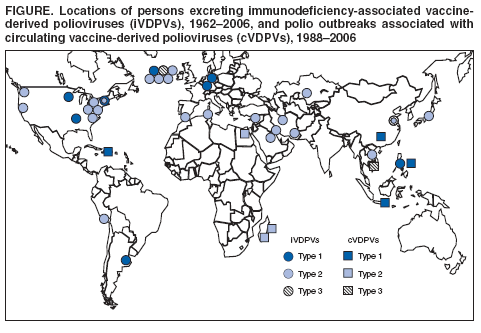
© cdc
Herd immunity used for fear and guilt
Vaccine side effects higher than cervical cancer risks
According to a recent Minnesota Department of Health (MDH) report, cancer of the cervix was the 14th most common malignancy among Minnesota women. It was the 17th most common cause of cancer death.
In Minnesota, according to the statistical information provided by the MDH (published at http://www.health.state.mn.us/divs/hpcd/cdee/mcss/documents/ccc.pdf), the incidence of cancer of the cervix among Minnesotan females of all races is a miniscule 6.8/100,000 population (ie, 6.8 newly diagnosed cases per 100,000 women per year).
The age-related peak incidence for a diagnosis of cancer of the cervix is 44 years of age. In the 40 – 44 year age group, the MDH says that there are 14 newly diagnosed cervical cancers per 100,000 per year, which means that 99,986 out of every 100,000 44 year-old women will not be diagnosed with cervical cancer in any given year. (Incidence is the term for the number of new cases of a disease diagnosed during a specified period of time.)
By the age of 50, the CDC reports, more than 80% of American women will have been infected with human papillomavirus (HPV) during their lifetimes. And yet, amazingly, over 99,000 out of every 100,000 women will never be diagnosed with cervical cancer. (It is useful to point out that deaths from cervical cancer are an even more miniscule 1.5 cases per 100,000 female population per year.) Those statistics say that the vast majority of girls who don’t go along with the crowd and re
Continue reading “Vaccine side effects higher than cervical cancer risks”
Hep. B vaccination x MS
Evolution of multiple sclerosis in France since the beginning of hepatitis B vaccination

Abstract
Since the implementation of the mass vaccination campaign against hepatitis B in France, the appearance of multiple sclerosis, sometimes occurring in the aftermath of vaccinations, led to the publication of epidemiological international studies. This was also justified by the sharp increase in the annual incidence of multiple sclerosis reported to the French health insurance in the mid-1990s. Almost 20 years later, a retrospective reflection can be sketched from these official data and also from the national pharmacovigilance agency. Statistical data from these latter sources seem to show a significant correlation between the number of hepatitis B vaccinations performed and the declaration to the pharmacovigilance of multiple sclerosis occurring between 1 and 2 years later. The application of the Hill’s criteria to these data indicates that the correlation between hepatitis B vaccine and multiple sclerosis may be causal.
Keywords: Hepatitis B vaccine, Multiple sclerosis, Demyelinating disease, Pharmacovigilance, Vaccine adverse events
Introduction
The first doubts regarding vaccines as a possible cause or exacerbation of multiple sclerosis (MS) were formulated by Miller more than half century ago [1]. Hepatitis B (HB) vaccine has been the subject of greatest concern, especially in France where mass HB vaccine administration was performed in a short time. In 1992, the World Health Organization (WHO) recommended undertaking a universal HB vaccination of all young infants in order to eradicate the HB virus. WHO explained that the teenagers’ vaccination could also be used in addition to or instead of the vaccination of young children in low-endemic countries. In 1994, the French health authorities launched a national vaccination campaign of all pupils in the first year of secondary school. The following year, HB vaccine was added to the national immunization program for all young babies and preteenagers. This intensive campaign had quickly exceeded its expected targets by also encouraging the adult population to be mass-vaccinated, whereas the vaccination of the infants remained less significant. This resulted in an unprecedented “wave” of immunization in adults, with 20 million French individuals vaccinated against HB, concentrated in 4 years, from 1994 to 1997.
MS cases in some vaccinated adults were rapidly notified to the French national pharmacovigilance system (ANSM), triggering investigation by this agency. This inquiry, started in 1994, was therefore already underway when French media revealed possible occurrence of post-immunization MS in 1998. This year, French health authorities abruptly terminated routine school-based vaccination of preteens, and adult HB vaccination began to be less widespread.
Several epidemiological studies have been evaluating the correlation between HB vaccination and MS in adults for a decade. Most of these publications found the absence of a link [2–6] or a slightly increased risk, but not sufficiently significant on the statistical level [7–9]. However, different opinions have also been formulated. A study aiming at quantifying underreporting in Fourrier’s article [8] was conducted by D. Costagliola on request of the French pharmacovigilance. This unpublished study showed by the “capture–recapture” method that the real number of MS cases linked to HB vaccine was 2–2.5 higher than the officially registered number [10]. This additional calculation makes Fourrier’s publication [8] clearly significant. Another case–control epidemiological study was conducted to evaluate serious post-vaccination adverse events registered in the United States through a spontaneous reporting system in the VAERS database. Adults receiving HB immunization had significantly increased odds ratios (OR) for MS (OR 5.2; CI 1.9–20) in comparison with an age-, sex-, and vaccine year-matched unexposed tetanus-containing vaccine group [11]. A Hernan’s paper, based on a case–control study in the United Kingdom within the General Practice Research Database (GPRD), found an increased risk (OR 3.1; CI 1.5–6.3) of MS within the 3 years following HB immunization [12]. In the same way, a French study on demyelination in childhood [13] showed that Engérix B® vaccine administration was associated with an increased trend of confirmed MS after 3 years (OR 2.77; CI 1.23–6.24).
On these grounds, we compared temporal HB vaccine dose distribution and MS occurrence in the French population, using the official data collected by the French pharmacovigilance system (ANSM) and the national health insurance (CNAM). The results confirmed, at the global population level, a significant correlation between the number of immunizations and both the number of MS cases declared to the pharmacovigilance system 1–2 years later and an overall increase in identified MS cases in the country.
Vaccine delivery using nanoparticles
Gates Foundation funds innovative global health projects including sweat-triggered vaccine delivery using nanoparticles

The Bill & Melinda Gates Foundation announced a few days ago 78 grants of US$100,000 each for new innovative global health projects. Among those aiming at more effective vaccines, one involves nanoparticles : “Sweat-triggered vaccine delivery: Carlos Alberto Guzman of the Helmholtz Centre for Infection Research in Germany with Claus-Michael Lehr and Steffi Hansen of the Helmholtz-Institute for Pharmaceutical Research will develop nanoparticles that penetrate the skin through hair follicles and burst upon contact with human sweat to release vaccines.” (press release)
[[[ Additional link suggested by Nanocolors :
Nano & vaccines : volumetry in patents since 2000
This chart was built by searching the Espacenet database for patents mentionning the prefixes “nano” and “vaccin” in their title or abstract.

New vaccines will permanently alter human DNA
Tap dancing
HPV vaccine
Catherine J. Frompovich via Activist post
One vaccine on the schedule for pre-teen and teenage boys and girls in the USA is the HPV (human papillomavirus vaccine) of which there are three brands: Gardasil®, Cervarix® and Gardasil 9®. Both Gardasil vaccines [1-2] are the proprietary properties of Merck and Company (USA), while Cervarix [3] is owned by GlaxoSmithKline (GSK) in the UK.
Originally, the HPV vaccine was promoted and pushed as a ‘cervical cancer preventive’ vaccine in girls and then a few years later, those same HPV vaccines morphed into prophylactic vaccines for boys, who don’t have a cervix! Interesting?! However, Big Pharma is never at a loss to spin pseudoscience to its financial benefits so it was able to convince the U.S. HHS/CDC/FDA that boys, too, had to receive the HPV vaccines, with equally devastating results as girls who received HPV vaccines have experienced
Those vaccine adverse horrors are tracked by S.A.N.E. VAX, whose website lists the horrible side effects of HPV vaccines as reported to the CDC’s VAERS reporting system. As of December 2016, 300 deaths were reported; 14,063 emergency room visits; 4,445 hospitalizations; and the list goes on and on.
Besides the MMR vaccines and influenza vaccines, the HPV vaccine is one of the more-often reported damaging vaccines, as reported to the VAERS system. And still, the medical profession pushes HPV vaccines like crazy: 3 shots over the course of six months costing mega bucks! As of 2017, the three-shot series in the USA costs between $390 and $500! In the UK, the cost is £185 per dose!
http://www.activistpost.com/2017/02/will-british-medical-journal-hpv-vaccine-misinformation.html
 What is this world without a further Divine purpose in it all? W. Whitman